

Car Key Replacement: Costs, Services, and Emergency Help from a Locksmith
Car key replacement from a locksmith covers cutting mechanical keys, programming transponder chips, and supplying or reprogramming remote key fobs so you can get back on the road fast. This guide walks through costs, the technical steps involved, mobile and emergency options, and how to pick a trustworthy automotive locksmith near you for quick, cost-effective service. Lost, broken, or non-working keys are a common headache — professional locksmiths cut downtime by combining on-site key cutting, electronic programming, and diagnostic tools. You’ll find practical cost factors, how transponder programming works, fob replacement choices, the mobile service workflow, and immediate steps to take during an emergency. The article uses checklists, comparison tables, and clear step-by-step explanations to help you evaluate options and contact an auto locksmith near me when needed, while keeping common search terms like locksmith to replace car key, car key replacement cost, and mobile car key replacement naturally included.
How much does car key replacement by a locksmith usually cost?
Price depends on the key type, your vehicle’s make and model, whether programming is required, and if you need on-site mobile service. Basic mechanical keys are the cheapest because they only need cutting. Transponder keys and remote fobs add electronics and programming, which raises the cost. Other drivers of price include travel or emergency surcharges, diagnostic time to identify the immobilizer, and whether aftermarket parts or OEM components are used. Knowing these factors helps you estimate likely ranges and decide whether to use a locksmith or go to the dealer when you need to replace a lost car key.
Below is a quick comparison table showing typical cost ranges by common key type so you can see where fees come from.
| Key Type | Typical Cost Range | Notes |
|---|---|---|
| Basic mechanical key | $10 – $100 | No programming needed; quick on-site service |
| Transponder key (chip) | $75 – $200+ | Requires diagnostic and programming equipment |
| Key fob / remote | $80 – $400+ | Includes remote electronics and possible blank sourcing |
This table highlights why modern keys cost more than simple blades. Next, we break down how costs change by key type and where programming fees fit in.
How do replacement costs change by key type?
Costs differ because each key type involves different parts and labor. A mechanical key needs a blank and cutting time. A transponder key adds a microchip and a programming session. A key fob may require sourcing a compatible remote and cloning or programming its electronics. Older vehicles often accept simple blanks, while newer models may use rolling codes or encrypted transponders that need more advanced tools. Choosing aftermarket blanks versus OEM parts also affects price and compatibility: aftermarket is cheaper but can require extra programming or adjustments.
When choosing a service, weigh parts compatibility, whether programming is done on-site or in a workshop, and whether the locksmith supports your vehicle’s immobilizer type. Those factors lead directly into programming costs covered next.
Will I pay extra for transponder key programming?
Yes — transponder programming usually adds fees for the technician’s time and specialized equipment to sync the chip with the vehicle’s immobilizer. You may also see diagnostic fees to identify the key system, travel or mobile surcharges, and higher rates if all keys are lost (some vehicles need manufacturer security codes or dealer tools). Many locksmiths can do full programming on-site; for vehicles with restricted systems, dealer involvement might be required, which raises the total. Always ask a locksmith about diagnostic and programming fees upfront so there are no surprises.
Knowing when dealer intervention may be needed helps you decide between convenience, speed, and potential extra cost. Next, we explain how transponder programming actually works.
How does transponder key programming work with locksmiths?

Transponder programming is the process where a locksmith synchronizes a key’s chip with the car’s immobilizer so the engine will start. The technician first identifies the immobilizer protocol, then uses programming equipment to write or clone the transponder code into a new key, and finally tests the key to confirm authentication with the vehicle. This step-by-step approach rebuilds the electronic link between key and car safely and reliably, restoring access and ignition. It also makes it clear when dealer-level tools might be needed.
Professional programming reduces the chance of security errors and often finishes on-site, avoiding a tow. In complex cases the locksmith will recommend next steps. Typical programming workflow:
- Diagnosis: Identify the immobilizer type and check if key data is available.
- Preparation: Get a compatible blank or transponder and ready the programming tools.
- Programming: Use diagnostic equipment to write the transponder code or pair the new key.
- Verification: Test ignition and remote functions to confirm successful programming.
These are standard, efficient steps — next we cover why hiring a pro is usually the better choice.
Why use a professional for transponder key programming?
A professional locksmith provides speed, correct security setup, and often a lower total cost than dealer replacement. Locksmiths commonly perform on-site programming, avoiding towing and restoring access faster. They use diagnostic tools that support many mainstream brands and immobilizer types, which reduces the risk of mistakes that can complicate recovery. A trained locksmith can also advise whether aftermarket keys or OEM parts are the right choice for your vehicle. For most drivers who need a quick, reliable fix, a qualified automotive locksmith near me is the practical option.
That raises a common question: can locksmiths handle every car model, or are there limits?
Can locksmiths program transponder keys for all vehicles?
Most locksmiths can program transponder keys for the majority of mainstream makes using universal programming equipment and manufacturer data. However, some luxury or very recent models use proprietary encryption or restricted systems that require dealer-only tools. When that’s the case, dealer involvement can add time and cost. A reputable locksmith will diagnose compatibility up front and tell you whether they can complete the job on-site or need to escalate to dealer tools. Checking a locksmith’s equipment and experience for your model sets realistic expectations and helps avoid delays.
Knowing when dealer-level tools are needed informs whether to pursue locksmith programming or dealer replacement. Next we look at fob replacement options.
What are the car key fob replacement options offered by locksmiths?
Locksmiths can reprogram your existing fob, source and program an aftermarket fob, or coordinate an OEM fob and programming if required. Each option balances cost, turnaround, and compatibility: reprogramming an existing fob is fastest and cheapest if the electronics work; aftermarket fobs are more affordable but may need extra setup; dealer-sourced OEM fobs guarantee compatibility but cost more. Many locksmiths handle on-site fob cloning and testing, making them a practical alternative to dealer-only solutions for most vehicle owners.
Compare common fob replacement approaches below to weigh pros, cons, and expected turnaround.
| Replacement Approach | Characteristic | Typical Outcome |
|---|---|---|
| Reprogram existing fob | Uses current electronics | Fast and inexpensive if the fob still works |
| Aftermarket blank + programming | Cost-effective option | Good turnaround; may require extra setup |
| OEM dealer fob + programming | Guaranteed compatibility | Higher cost but full feature support |
This comparison helps you pick the route that fits your budget and urgency. Next, the practical steps locksmiths follow when replacing and programming fobs.
How do locksmiths replace and program car key fobs?
When replacing a fob, locksmiths source a compatible blank or aftermarket remote, cut or attach any mechanical blade if needed, and program the unit with diagnostic tools to pair it with the vehicle’s receiver. They test all remote functions — lock, unlock, trunk release, panic — and verify proximity or passive entry where applicable. If the key includes an immobilizer chip, that’s programmed as well. On-site programming is common, and a technician will advise if dealer-level coding is required. A successful job restores remote convenience and keeps security features working correctly.
Knowing the difference between fob replacement and key cutting avoids confusion when you request service.
Key fob replacement vs. key cutting — what’s the difference?
Fob replacement focuses on the electronic remote and possibly a transponder chip; it requires sourcing compatible electronics and programming them to your car. Key cutting is purely mechanical: shaping a metal key blade to match a lock or ignition with no electronic work. Cutting is usually fast and inexpensive; fob replacement involves parts sourcing and programming time and can cost more. Check whether your issue is mechanical (key won’t turn) or electronic (remote or immobilizer fault) to pick the right service.
That distinction helps you request mechanical cutting, electronic fob work, or a combined locksmith visit that handles both.
How does mobile car key replacement service work?
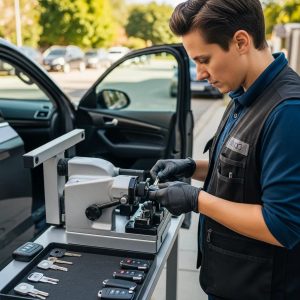
Mobile car key replacement brings cutting and programming tools to your location so you can get on-site key duplication, transponder programming, and fob replacement without towing. The typical mobile workflow has four steps: you call or request service online, the technician verifies vehicle details and identity, the locksmith travels with equipment to perform cutting and programming on-site, and the technician tests the new key or fob before leaving. Mobile units carry blanks, cutting machines, and programming tools for most mainstream systems, offering convenience and faster restoration than workshop-only services.
Below is a brief table comparing mobile service features so you know what to expect from an on-site automotive locksmith.
| Feature | Typical Mobile Value | Notes |
|---|---|---|
| Response / arrival | Local response within service area | Time varies with location and demand |
| On-site equipment | Cutting, programming tools, blanks | Enables full on-site replacement |
| Payment & guarantees | Card / cash options; limited warranty | Confirm terms with the technician |
These points set realistic expectations for mobile service and lead into the benefits of choosing a mobile automotive locksmith near me.
What are the advantages of mobile locksmith car key replacement?

Mobile locksmith service is convenient, faster, and avoids towing costs by bringing full replacement capabilities to your vehicle. On-site work saves time when you’re stranded, and technicians can diagnose immobilizer and remote issues immediately, often resolving the problem during the same visit. Mobile units also enable secure ID checks and careful handling of keys and programming gear to protect vehicle security. For many drivers, mobile service is the most practical, cost-effective choice for lost or broken key situations.
Those benefits make mobile service especially valuable in emergency car key replacement situations, which we cover next to help you prepare.
How do I find reliable mobile car key replacement locksmiths?
Start by checking credentials and equipment capability: read reviews, confirm the locksmith performs on-site transponder programming, and verify the vehicle types they support. Ask about diagnostic procedures, the brands of tools they use, warranty or guarantee policies, and what identification they require on site. Request clear pricing that separates parts, programming, and travel fees so there are no surprises. A short checklist and a few focused questions help you identify competent mobile providers who deliver fast, secure, and professional automotive locksmith services.
The next section explains what to do in an emergency when you need immediate help with lost keys.
What should you do in an emergency car key replacement?
In an emergency, prioritize safety, preserve your options, and contact a professional automotive locksmith near me or roadside assistance for fast help. Immediate steps: move to a safe, well-lit spot if possible, check for a spare key, and have vehicle details (make, model, year) plus proof of ownership ready for verification. Emergency calls may incur higher fees for after-hours or rapid response, so weigh urgency against cost; still, locksmiths often restore access faster than towing to a dealer. Keeping a spare key and noting key registration with your insurer or roadside provider can reduce stress and expense later.
Use this quick checklist while you arrange emergency replacement with a trained locksmith:
- Stay safe: Move to a well-lit, secure area if you can.
- Search for spares: Check for a household or valet spare before calling.
- Gather documentation: Have your vehicle registration and ID ready.
- Contact help: Call a locksmith or roadside assistance for emergency service.
- Ask about surcharges: Confirm any after-hours or rapid-response fees before service starts.
This checklist reduces confusion and helps the technician assist you faster. Next, we cover expected response times and costs in emergencies.
How quickly can locksmiths provide emergency car key replacement?
Response times depend on local availability, time of day, and distance to the nearest mobile unit. Many locksmiths aim to arrive within 20 to 60 minutes in urban areas when available. Speed improves with clear location details, accurate vehicle information, and if the locksmith already carries compatible blanks and programming tools for your model. To speed things up, be ready with precise location directions or coordinates, confirm your vehicle year and key type, and give prompt authorization to begin work. Faster arrival and turnaround are usually possible when a technician is already working nearby and equipped for your vehicle.
Knowing typical response windows helps you decide whether emergency locksmith service is necessary or if a scheduled appointment will suffice.
What do emergency services cost and what should you consider?
Emergency locksmith work usually includes base charges for labor and parts plus possible surcharges for after-hours or immediate-response calls, which can raise the total compared with scheduled service. Consider whether you need on-site programming (transponder or fob), which takes extra equipment time and may increase fees, and whether your vehicle requires OEM components that must be ordered. When weighing value, compare the convenience and safety of on-site emergency service against the higher cost; for many drivers, quick restoration of mobility and avoiding towing justify the surcharge. Always ask for a clear estimate before work begins so you can make an informed choice.
If you decide to proceed, contact a qualified automotive locksmith near me, be ready to verify ownership, and confirm payment terms so the technician can restore access quickly.
Author: Ben Joe, Locksmith tech With over 10 years of experience